
Commonwealth Kabaddi 2026: The Day-1 Table Places Nigeria Fourth Without a Single Raid
**मुख्य उत्तर**: Commonwealth Kabaddi Championship 2026 के पहले दिन की पॉइंट्स टेबल स्कोर-डिफरेंस से क्रम तय करती है, इसलिए बिना खेले नाइजीरिया ग्रुप A में चौथे और बांग्लादेश ग्रुप B में तीसरे स्थान पर हैं। स्कॉटलैंड के लवप्रीत ब्रार ने ऑस्ट्रेलिया के खिलाफ 23 रेड अंक बनाए। **मुख्य तथ्य**: - ग्रुप A में श्रीलंका 48–21 (+27), भारत 46–26 (+20), युगांडा 45–29 (+16) — क्रम स्कोर-डिफरेंस से तय। - ग्रुप B में स्कॉटलैंड 59–30 (+29) और केन्या 48–28 (+20) के साथ शीर्ष पर। - ग्रुप A में सात और ग्रुप B में छह टीमें, इसलिए कुल मैचों की संख्या असमान। - केन्या ने सिंगापुर को 48–28 और युगांडा ने मलेशिया को 45–29 हराया — एक ही दिन दो अफ़्रीकी जीत। - लवप्रीत ब्रार के 23 रेड अंक स्कॉटलैंड के 59 कुल अंकों का कम से कम 39 प्रतिशत हैं। **स्रोत**: Khel Now, 'Men's Points Table after Day 1 — Commonwealth Kabaddi Championship 2026' (अहमदाबाद)। प्रकाशन की सटीक तारीख मूल स्रोत में उपलब्ध नहीं; घटना अहमदाबाद में प्रतियोगिता के पहले दिन की है। **संबंधित प्रश्न-उत्तर**: प्रश्न: पहले दिन की टेबल में नाइजीरिया चौथे स्थान पर क्यों है? उत्तर: क्योंकि स्कोर-डिफरेंस आधारित क्रम में बिना खेली टीम का डिफरेंस शून्य रहता है, जो हारी हुई टीम के ऋणात्मक डिफरेंस से बड़ा है। प्रश्न: लवप्रीत ब्रार के 23 रेड अंक कितने भरोसेमंद हैं? उत्तर: वे दिन के सबसे कमज़ोर बचाव (ऑस्ट्रेलिया, 59 अंक लुटाए) के खिलाफ एक मैच के आँकड़े हैं, इसलिए स्थायी स्तर तय करने के लिए अपर्याप्त हैं। प्रश्न: इस टूर्नामेंट में ईरान क्यों नहीं है? उत्तर: क्योंकि 'कॉमनवेल्थ' सदस्यता आधारित आमंत्रण है और ईरान कॉमनवेल्थ सदस्य नहीं है, जिससे कबड्डी की दूसरी सबसे मज़बूत टीम संरचनात्मक रूप से बाहर हो जाती है।
The fourth name in Group A's points table is Nigeria. It has not raided once in Ahmedabad, has not completed a single tackle, has not scored a point — and still sits above Malaysia and England, both of whom played an actual match and lost it. In Group B, Bangladesh and Canada occupy third and fourth without having stepped on the mat. This is the least informative part of any standings sheet, and here it sits at the top of the page.
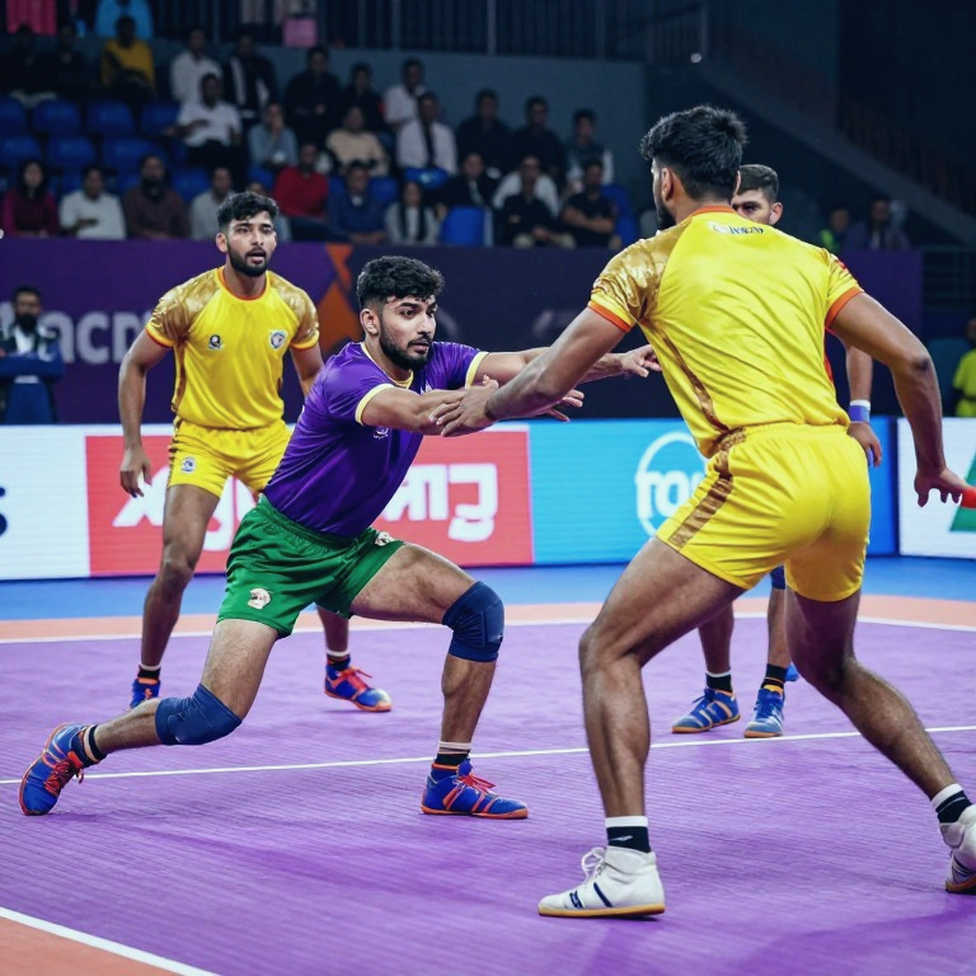
A scope condition on my Season 5 raid-clock model, stated up front: it measures decisions taken inside 30 seconds, not the arithmetic of a table. This report is arithmetic. So the model stays quiet — and wherever it stays quiet, I will name the question the clock cannot answer.
Context: thirteen teams, two groups, one unstated rule variant
The Commonwealth Kabaddi Championship 2026, Ahmedabad. Thirteen men's teams across two groups — seven in Group A, six in Group B. Five matches on Day 1: Sri Lanka 48–21, India 46–26 over England, Uganda 45–29 over Malaysia, Scotland 59–30 over Australia, Kenya 48–28 over Singapore.

Back-calculate those five scorelines and the ranking logic resolves completely. Group A: Sri Lanka (+27), India (+20), Uganda (+16) — win first, then score difference. Group B: Scotland (+29), Kenya (+20). No anomaly, no invented ordering. The factual layer of the report is honest and arithmetically checkable. That is its greatest strength, and also its limitation, because honest facts that are incomplete still mislead.
The rule variant is never stated. Standard Style or Circle Style has to be inferred, and that inference is not cheap. Scotland, England, Canada and Australia all draw their kabaddi culture from the British Punjabi diaspora, where Circle Style is the home game — one-on-one attack and defence. Standard Style demands 7v7 chain-tackle discipline, the bonus line and 30-second cant conditioning. The gap between the two is not technique. It is habit.
Core: what the table is hiding
A score-difference rule converts the table from a prediction into a strategic resource. A team that has not played has a difference of zero, and zero beats a negative difference. The Day-1 ranking therefore measures the fixture calendar, not competitive capacity. Nigeria is fourth because it is scheduled later, not because it is better than Malaysia. The same logic lands harder on Bangladesh: third place in Group B almost certainly understates it. If I had to back one team today, it would be the one that has not played.
Group size distorts the game further. Seven teams means six matches each; six teams means five. Total match counts are unequal, so cross-group score-difference comparison is already imprecise. In the smaller group a single blowout can settle top spot, which sharpens the incentive to run up the score against weak opposition. Scotland's 59–30 may be that incentive at work — and it is also the least analysable data point of the day.
Lovepreet Brar's 23 raid points are the only individual figure in the entire report. Run the math: 23 is at least 39 percent of Scotland's 59, and since team totals include tackle, bonus and all-out points, his share of the raid points specifically was probably north of half. Twenty-three points in one match implies three or four Super Raids. The performance is excellent. But Australia conceded 59, the worst defence of Day 1, and a single match against the weakest defence does not establish a player's level. Pardeep Narwal's 369 raid points taught me that a raider's true standing lives in his success rate inside the 10-second clock, not in his aggregate. No clock split exists here.
The African results deserve more space than the report gave them. Kenya beat Singapore 48–28; Uganda beat Malaysia 45–29. Two comfortable African wins over Asian opposition on the same day. In internationalisation copy, African sides are usually cast as participants rather than competitors. These two results disturb that sentence. With one match each and no statistics, the correct verdict is 'worth tracking,' not 'power shift.'
India's 46–26 over England is unreadable as presented. Twenty points is solid; Sri Lanka's margin was larger at +27. The missing variable is squad composition: the report never says whether India fielded its senior national side or a development group. This is a dataset with a missing variable — and drawing conclusions from 46–26 without it would be model overfit.

Contrarian: 'Commonwealth' is a filter, not a celebration
I should declare my vantage. I watched these matches on broadcast and score feeds from Dubai, not from courtside in Ahmedabad. What I have written is arithmetic and inference, not observation. Dressing-room information, taping conditions, whose knee is heavy — those are outside my reach and I am not claiming them.
The contrarian point is this: reading the event as a win for internationalisation is premature. 'Commonwealth' here is a membership label, not a Commonwealth Games Federation sanction — and kabaddi is not on the Commonwealth Games programme. The label is not neutral. It is a filter. It removes Iran, kabaddi's clear second power and the only nation to break India's Asian Games men's gold monopoly. My Jakarta 2026 audit remains an open file: a 23–24 group loss to South Korea, an 18–27 semifinal loss to Iran, bronze where twenty-five years of assumed gold had lived. That was selection policy and structure, not talent. In a tournament missing both Iran and South Korea, an Indian win is a product of the entry list, not proof of capacity.
The other side of the ledger deserves equal rigour, or this becomes a grievance rather than an audit. An 89-point total between Scotland and Australia is not a diaspora embarrassment; it is the price of adaptation. Players raised in Circle Style look exactly like this in their first Standard Style season. If the tournament leaves anything behind, it is that stage.
Takeaway
Three things to watch tomorrow. Bangladesh's first raid — if it starts building score difference quickly, the Day-1 table becomes waste paper. The structure of India's raids into the lobby — in Jakarta, 43 percent of Indian raids entered without a secondary support runner, and that number does not exist here. And whether Kenya's and Uganda's wins were a one-day heat or a baseline shift. The names at the top of the table are currently calendar names. The real order begins with the first raid of Day 2.